The Pi Symbol (π): What It Means, Its Value, and How to Type It
π is the ratio of any circle's circumference to its diameter, a constant that equals about 3.14159. This guide explains what the symbol means, lists its digits and approximations, and shows how to type π on Windows, Mac, HTML, and LaTeX.
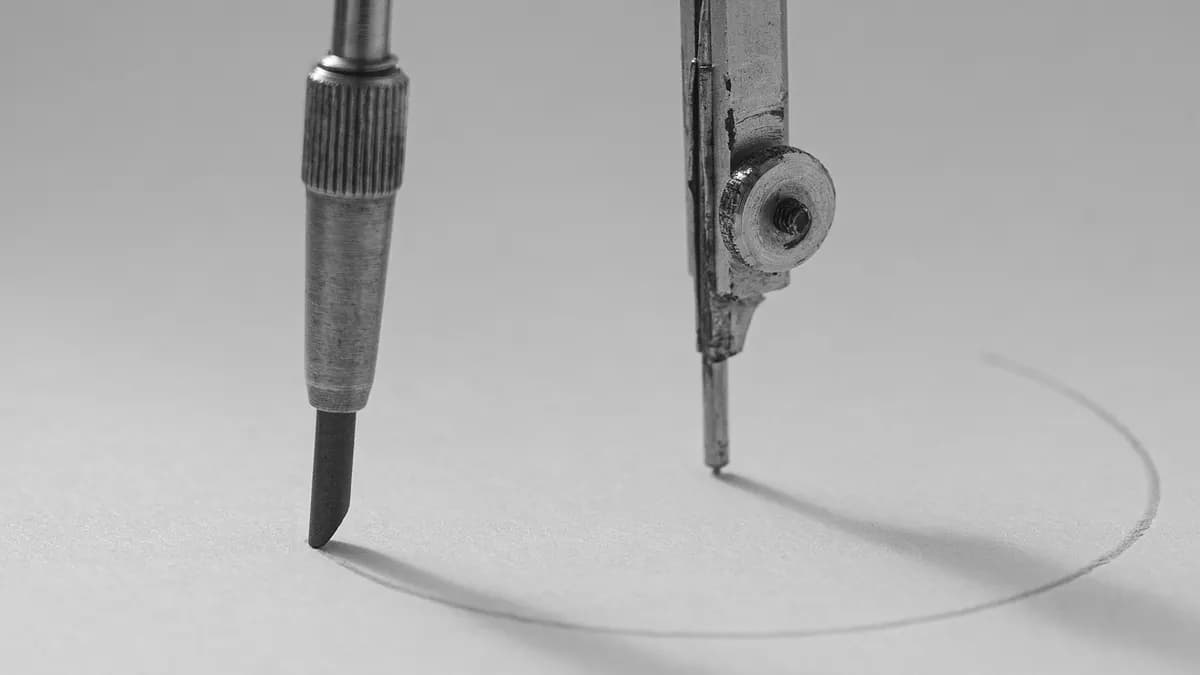
π is the Greek letter pi, and it names the ratio of any circle's circumference to its diameter:
π = C / d. That ratio is the same for every circle. Its decimals run forever without repeating, so π is irrational and cannot be written exactly as a fraction. The symbol stands in for the full value.
Want to put π to work on a real circle? Try our circumference calculator.
When you see π in a formula, read it as the constant value it represents. It behaves like any other number. The symbol just saves you from writing all those digits every time.
Why π is always the same number
Take any circle and divide the distance around it by the distance across it. Measure all the way around (the circumference) and straight across through the center (the diameter), then divide the first by the second. You always land on the same value, whatever the circle's size.
A bottle cap, a stadium, the orbit of the Moon: every circle gives the identical ratio. Double the diameter and the circumference doubles too, so the ratio holds. That is what makes π a constant rather than a measurement. It is built into the geometry of circles.
You can check it roughly with a string and a ruler. Wrap a string around a cup, mark the length, then lay it flat against the cup's width. The wrapped length comes out a little over three times the width every time, and careful measuring lands near the true value, whether the cup is small or large.
The value and digits of π
To fifteen decimal places, π has a fixed, known value. Nobody writes it all out in practice. Two approximations cover almost everything: one short decimal for homework and estimates, and one handy fraction that drifts after the second decimal.
A lesser-known fraction does far better, matching π to six decimal places. None of these is exact, though. Only the symbol π names the true value.
The digits have been computed into the trillions, and no repeating block has ever appeared. That matches what proofs of π's irrationality guarantee. It is exactly why the symbol exists: there is no finite decimal or fraction to write in its place, so mathematicians give the number a name and carry it through every calculation as π.
How to type the pi symbol
Most systems have a direct shortcut, so you rarely need to paste π from somewhere. Pick the row for your tool below. The lowercase π is the one you want for the circle constant.
The capital letter Pi (Π) is a different symbol. In math it means a repeated product, and its codes shift accordingly.
Where π shows up
Any time a circle, sphere, or cylinder is involved, π appears. It is the bridge between a straight measurement, like a radius or diameter, and a curved one, like an arc, area, or volume. Two of these formulas have their own tools: the area of a circle calculator and the cylinder volume calculator.
π also turns up far from geometry. It appears in trigonometry, where angles are measured in radians and a full turn is two pi, in statistics through the normal distribution, and in physics through waves and oscillations. The circle is still where π earns its name.
Whenever a calculation involves a circle, the symbol π is doing the work of an endless decimal in a single character. Reach for a short approximation when you need a number, and keep the symbol when you need the exact value.
Common questions
No. The fraction 22/7 is close but wrong after the second decimal. π is irrational, so no fraction can equal it exactly. It is only a convenient stand-in.
Far fewer than people imagine. With fifteen decimal places you can calculate the circumference of the entire solar system to within the width of an atom. For ordinary work, a couple of decimals is more than enough.
Pi Day falls in mid-March, on the date written as 3/14 in month/day format, which matches the first digits of π. It is an informal holiday for math, often celebrated with pie, and it happens to be Albert Einstein's birthday.